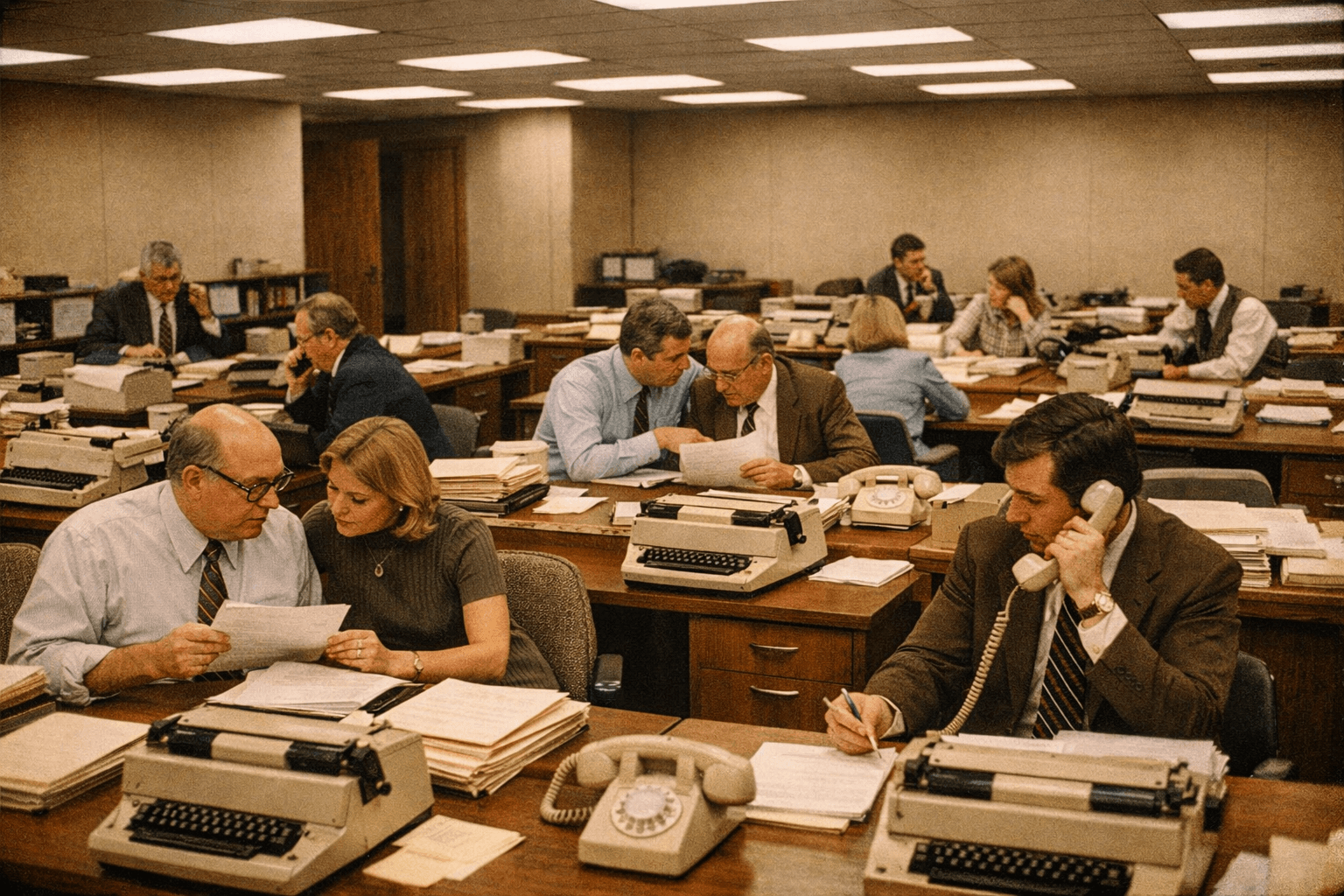
Dickensian Dynamics
Regional Insurance · Hartford, CT
Regional insurance firm deploys the Calendar Saturation Protocol and achieves 94% meeting density across all workdays.
The Challenge
Dickensian Dynamics, a regional property-and-casualty insurance underwriter founded in 1963, entered 2019 facing a peculiar form of organizational crisis: too much unstructured time. Insurance underwriting, as a practice, involves periods of genuine work interrupted by periods of administrative pause. Claims adjudication demands focus and judgment, but the company could not fill all working hours with claims alone. The executive leadership recognized that the void was being filled with informal collaboration, casual consultation between departments, and spontaneous problem-solving—all of which contributed to a sense that work was purposeful and social.
In early 2019, the board directed the Chief Operating Officer to eliminate this void entirely. The directive was explicit: 'No employee should experience unscheduled time. Every minute from 8 a.m. to 5 p.m. should be accounted for in a meeting, call, or structured initiative.' The company had inherited the logic of manufacturing efficiency without any of manufacturing's capacity constraints. The result was a challenge: how to fill nine hours per workday with eight hours of actual work?
The Engagement
Gristmill responded with a two-component strategy: the Calendar Saturation Protocol to manage meeting proliferation at the structural level, combined with strategic communications initiatives to justify the density to the workforce.
Implementation Timeline
Key Metrics
“When we started, people complained about meetings. By month four, they stopped complaining. They stopped asking for unscheduled time. They stopped expecting to think. The meetings were no longer an interruption—they were the job. The elegance of the Protocol is that it redefines productivity as attendance, not output.”

Outcome
Dickensian Dynamics's case became a proof point for corporate time management in the insurance industry. The company reported no change in claims processing speed or accuracy, no improvement in customer satisfaction, and no increase in underwriting volume. What changed was the structure of the workday itself. Employees could no longer claim that their time was their own. Every minute belonged to the organization.
By 2022, the company's meeting culture had matured to the point that scheduling a one-on-one discussion or allowing flexible work time was viewed as a failure of management discipline. The white space that once contained innovation and relationship-building had been permanently occupied by necessity and procedure.
Interested in outcomes like these?
Request an engagement and a member of our Workforce Stabilization Team will be in touch within three to five business quarters.
Request an Engagement