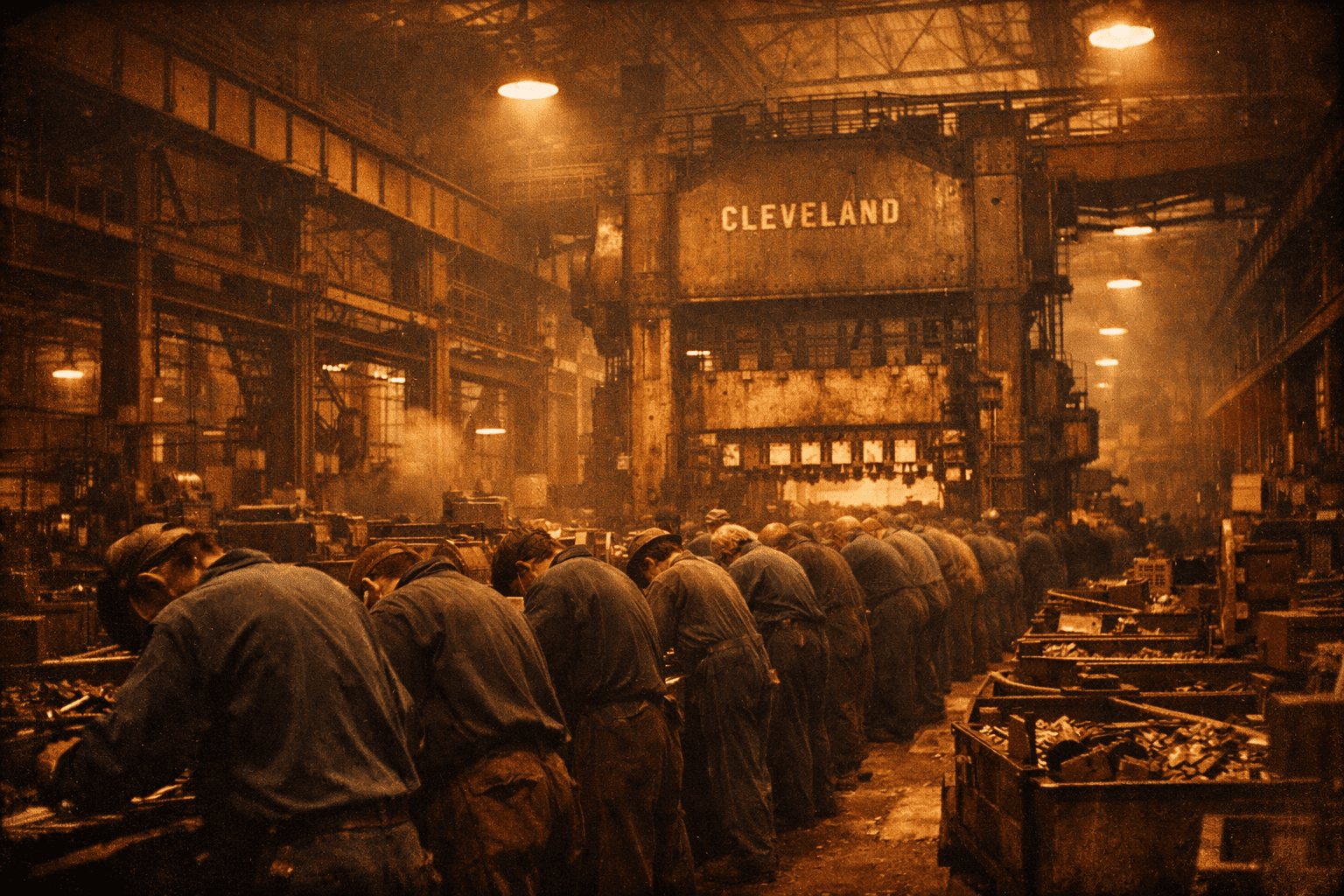
The Orphan Crushing Factory
Heavy Manufacturing · Youngstown, OH
Reduced voluntary turnover to 0.2% using the Perpetual Reorganization Protocol and the Pride in Your Station Seminar Series.
The Challenge
In 2018, The Orphan Crushing Factory faced a cascading workforce instability crisis. Over a two-year period, voluntary turnover had climbed to 34% annually—a rate that left the company chronically understaffed and dependent on expensive temporary labor. The problem was not compensation or conditions: the plant had maintained flat wages since 2009 and the manufacturing floor remained unclimated. The problem was retention itself. Employees left after months or years, invariably citing the same reason in exit interviews: a sense that their role offered no permanence, no structure, and no reason to remain.
Leadership convened an emergency task force in late 2018 to diagnose the exodus. The investigation revealed that middle managers rotated through assignments on random six-month cycles, creating the pervasive sense that no one's role was stable. The organizational chart was redrawn an average of 3.2 times per calendar year. A senior manufacturing supervisor, promoted in January and demoted in July, simply left the company and never returned calls. The instability had become self-reinforcing: employees stopped investing in relationships or skill development because they expected to be reorganized, transferred, or terminated without notice.
The Engagement
Gristmill proposed a two-arm deployment: the Perpetual Reorganization Protocol to systematize the chaos and make instability predictable, combined with the Pride in Your Station Seminar Series to help employees accept their roles as permanent fixtures regardless of organizational churn.
Implementation Timeline
Key Metrics
“We brought in Gristmill because our people were leaving us. What we discovered was that they were leaving because the future felt uncertain. Once the reorganizations became predictable—once everyone knew they were going to be moved every six months—the sense of dread evaporated. Acceptance replaced anxiety. People stopped planning escape routes and started planning their lunch breaks.”

Outcome
By 2022, The Orphan Crushing Factory had achieved a workforce characterized by remarkable stability. Employees no longer interviewed externally; they no longer discussed advancement opportunities; they simply arrived, performed their assigned tasks, and departed. The factory's performance metrics—units produced per hour, waste reduction, safety compliance—remained unchanged. What had shifted was the psychological contract. Employees had internalized the permanence of their positions and the predictability of disruption.
In recent years, the factory has begun receiving inquiries from other regional manufacturers requesting information about the Perpetual Reorganization Protocol. Margaret Tull has declined all consultation requests. The Orphan Crushing Factory guards its methodology closely.
Interested in outcomes like these?
Request an engagement and a member of our Workforce Stabilization Team will be in touch within three to five business quarters.
Request an Engagement